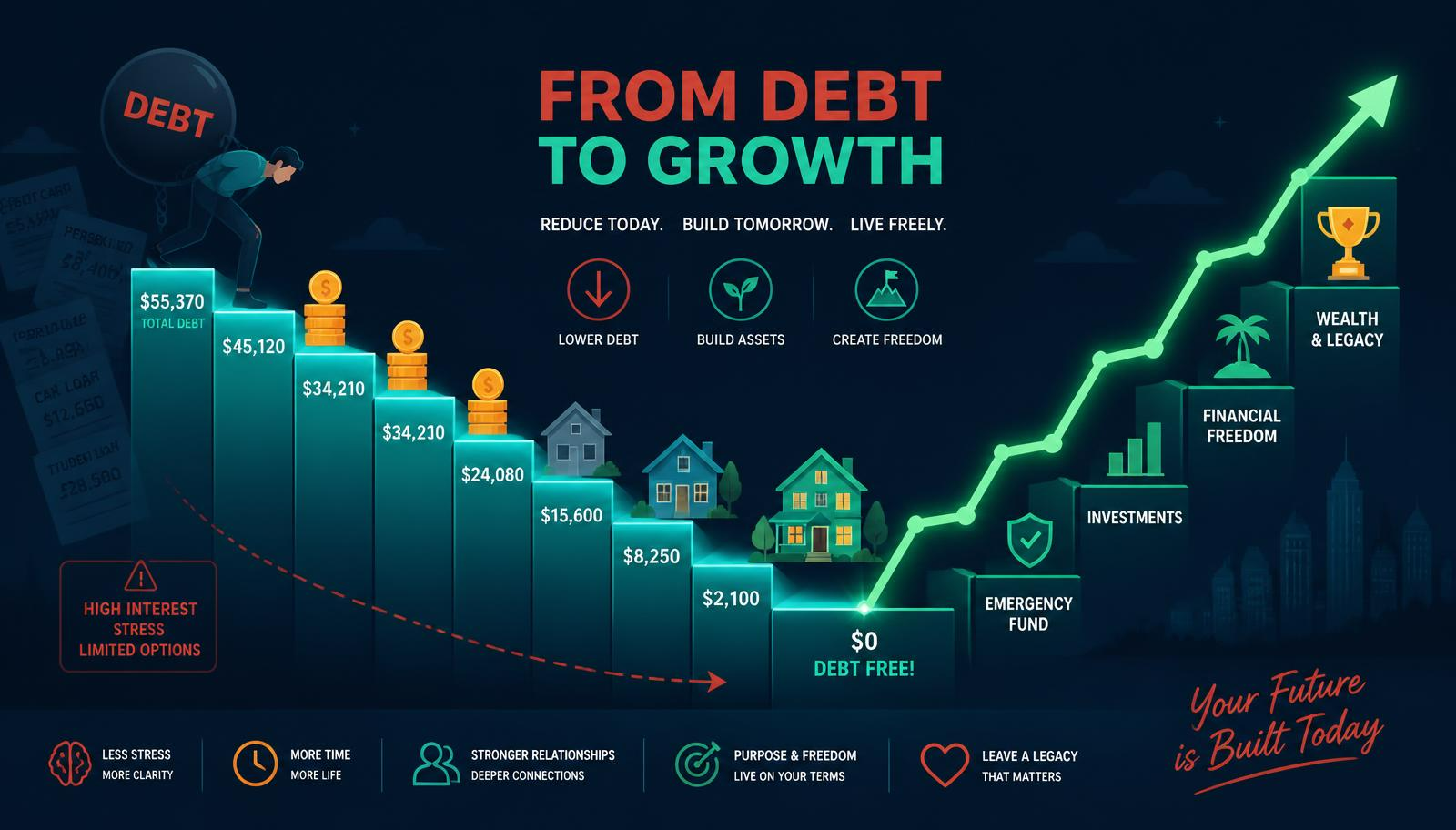
Almost nobody wakes up in debt by accident. It arrives quietly — a card used for groceries in a thin month, a car repair put on finance, a medical bill that could not wait, a business idea that needed one more push. Each decision made sense on its own day. It is only when you add them together that the number becomes frightening, and by then most people have stopped adding them together at all. That avoidance is the single most expensive habit in personal finance, and it is also the first one you can break, today, for free.
Getting out of debt begins with an honest page. Not a budget, not a spreadsheet system, not an app — a page. Write down every balance you owe, the interest rate attached to it, the minimum payment, and the day of the month it is due. Most people find the total is different from the number they had been carrying in their head, and it is usually smaller than the fear. Even when it is larger, something important changes: a vague dread becomes a finite figure, and finite figures can be attacked with a plan.
The second beginning is arithmetic, not willpower. Work out exactly how much money arrives each month and exactly how much leaves. The gap between those two numbers is your payoff engine, and everything else on this site exists to make that gap bigger — by trimming what leaves in cutting your costs, by lowering the interest that eats your payments in consolidation, and by raising what arrives in growing your income. A household that frees $400 a month and aims all of it at debt does not shorten a five-year plan by a few weeks. It usually cuts it in half, because every dollar of principal you kill stops generating interest forever.
The third beginning is order. Two debts of the same size are not equally urgent. Paying in the right sequence — smallest balance first for momentum, highest rate first for maths, or the hybrid most households should actually use — is the difference between a plan that finishes and a plan that quietly stalls in month seven. That decision is worked through with real numbers in payoff methods.
The fourth beginning is protection. The reason most payoff plans fail is not laziness; it is a broken washing machine. Without a small buffer, every ordinary emergency goes straight back onto a credit card and undoes months of progress. A starter fund of even $500, built before you go hard at the debt, is what turns a plan into a plan that survives contact with real life. That is the whole argument of the emergency fund guide.
And the fifth beginning is the one people skip: your head. Debt is a financial problem that behaves like an emotional one. Shame makes people stop opening letters. Panic makes people take terrible refinancing deals at 2am. Hopelessness makes people decide the number is too big to bother with. Ten calm minutes a day — through meditation, prayer or the mindset work in manifestation — is not a substitute for arithmetic. It is what keeps you doing the arithmetic in month fourteen, when the novelty has worn off and the finish line is still out of sight.
Put those five beginnings together and you have the shape of every successful debt story we have ever read: face the number, widen the gap, attack in order, protect the plan, and stay steady. It is not glamorous and it is not fast, but it is reliable — and unlike almost everything else in money, it works the same way whether you owe $3,000 or $80,000. The Debt Escape Plan walks you through all six stages in order, with a diagnosis quiz and a payoff calculator built straight into the page, and the video library collects every free money video we have gathered to keep your motivation topped up along the way.
One last thing worth saying plainly, because nobody says it often enough: being in debt is not a verdict on your character. It is a maths problem wrapped in a feeling. Solve the feeling enough to look at the maths, and the maths will do what maths always does — behave predictably. People who owed more than you, with less income than you, have paid it all off. There is no reason on earth that cannot be you.